Scouting America is one of the largest Scouting organizations in the United States of America and one of the largest youth organizations in the United States, with more than 2.1 million youth participants and nearly 800,000 (approx.) adult volunteers. Scouting America was founded in 1910, and since then, more than 110 million Americans have been participants in programs at some time. Scouting America is part of the international Scout Movement and became a founding member organization of the World Organization of the Scout Movement in 1922.
Scouting America’s goal is to train youth in responsible citizenship, character development, and self-reliance through participation in a wide range of outdoor activities, educational programs, and, at older age levels, career-oriented programs in partnership with community organizations. For younger members, the Scout method is part of the program to instill typical Scouting values such as trustworthiness, good citizenship, and outdoors skills, through a variety of activities such as camping, aquatics, and hiking. In order to further these outdoor activities, Scouting America has four high-adventure bases: Northern Tier (Minnesota, Manitoba, and Ontario), Philmont Scout Ranch (New Mexico), Sea Base (Florida), and Summit Bechtel Reserve (West Virginia).
The traditional Scouting divisions are Cub Scouting for children in grades K-5, Scouts BSA for youth ages 11 to 17 and Venturing and Sea Scouting for young men and women ages 14 (or 13 and having completed the 8th grade) to 20.
Scouting America operates traditional Scouting by chartering local organizations, such as churches, clubs, civic associations, or educational organization, to implement the Scouting program for youth within their communities. Units are led entirely by volunteers appointed by the chartering organization, who are supported by local councils using both paid professional Scouters and volunteers.
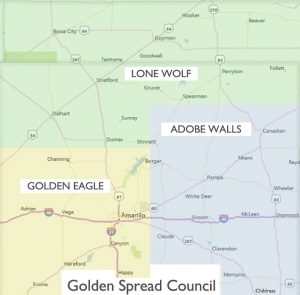
The Golden Spread Council consists of a 27 county geographical area in the Texas and Oklahoma panhandles and is divided into three districts: Adobe Walls District, Lone Wolf District, and Golden Eagle District.
Scouting needs are served from our administrative office at 401 Tascosa Road in Amarillo, known as the Scout Service Center. This administrative office handles all event registrations, processing of membership applications, camping reservations plus a whole host of training aids and audio-visuals designed to assist volunteer leaders in understanding their roles in the Scouting program.
History of our Merged Councils
Golden Spread Council ? - 2026
[details coming soon]
South Plains Council
In the fall of 1924, Mr. L.S. Harkey approached Mr. K.N. Clapp with the idea of organizing an Area Council of the Boy Scouts of America. Mr. Clapp agreed to help, and they gathered a group of men together including Sam Henry, Sr. of Lubbock, Marshall Mason of Post, Joe N. Spikes and Dr. J. C. Loveless of Lamesa and made an application for local Council Charter.
The National Council chartered the South Plains Council, Boy Scouts of America in January 1925.
The first president of the Council was Mr. Sim O’Neal, assisted by Vice-President Mr. Clapp, and the first Scout Executive was Mr. H.B. Palmer. Mr. Clapp organized a Scout Troop, and this was used as an exhibition troop. The Troop was taken from town to town throughout the area of the Council, where they put on demonstrations of scouting skills and camped in the City Square. Troops were organized throughout the area by this procedure.
The first camp of the Council was held in July 1925, at Ruidoso Springs, New Mexico, nearly 300 miles from Lubbock. 142 boys and 34 men camped for 10 days. The Council quickly grew to at least 12 Troops actively camping, with a membership of 306 boys.
The Central Plains Council 1922 - 1930
In 1922, a second class council was organized with an office in Plainview. Comprised of the following counties: Briscoe, Castro, Floyd, Hale, Lamb, Motley and Swisher. In 1931 transferred to Direct Service then to South Plains Council in 1936.
Researched by: Harry B. Massingill, Jr., District Executive – April 1987.
Revised: 1/91
